
Installation Sales Navigator Extension on Chrome
16 Oct 2026, 05:00 PM











 By Admin
Digital marketing has become one of the most important growth channels for modern businesses. Customers now discover brands through search engines, social media, email, online communities, websites, and digital recommendations before they ever speak with a sales representative. As a result, businesses need more than creative campaigns to compete effectively. They need reliable technology that helps them understand their audience, create meaningful experiences, automate repetitive activities, and measure the results of every marketing investment.
The good news is that businesses of every size now have access to powerful marketing technologies. From website analytics and search engine optimization to customer relationship management, email automation, social media management, project collaboration, and artificial intelligence, the modern marketing technology ecosystem offers solutions for almost every stage of the customer journey.
At Nexus, we believe technology should solve real business problems. Marketing tools should not simply add more software to your organization. They should help your team work smarter, understand customers better, reduce repetitive tasks, and make decisions based on reliable information. The right combination of tools can transform marketing from a collection of disconnected activities into a measurable and scalable business function.
In this guide, we explore 10 essential marketing tools and technology categories that businesses should consider when building a modern digital marketing strategy. Some tools are designed for specific tasks, while others can become central components of a broader marketing technology stack.
Marketing teams are expected to generate awareness, attract qualified prospects, nurture leads, support sales teams, retain customers, and demonstrate measurable return on investment. Managing all of these responsibilities manually is difficult and often leads to inconsistent processes.
Marketing technology helps solve this challenge by bringing automation, analytics, customer data, and collaboration into everyday workflows. Instead of spending hours compiling reports or manually following up with every prospect, teams can use technology to automate repetitive work and concentrate on strategy, creativity, and customer relationships.
The right marketing technology does not replace strategy or creativity. It gives your team the information, automation, and efficiency needed to execute a better strategy.
Nexus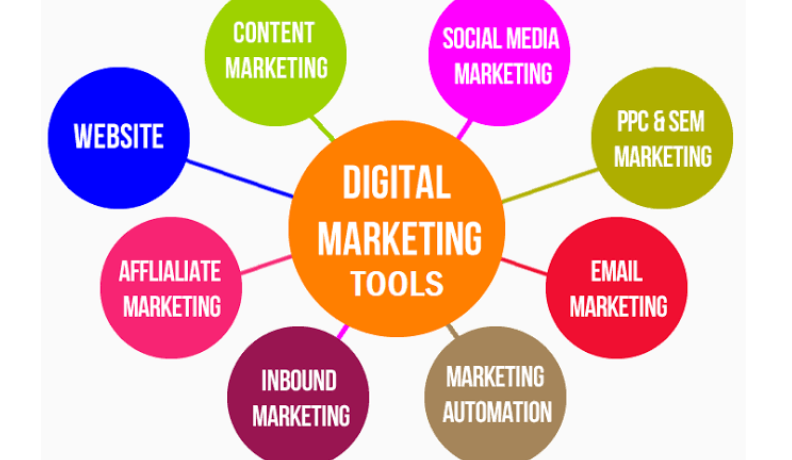
There is no universal marketing tool that is perfect for every organization. Your ideal technology stack depends on your industry, target audience, marketing goals, team size, existing systems, and budget. However, the following tools and categories cover some of the most important capabilities required by modern marketing teams.
Your website is one of the most important assets in your digital marketing strategy, but website traffic alone does not tell you whether your marketing is working. Analytics helps you understand what visitors are doing after they arrive on your website.
Google Analytics can help businesses analyze traffic sources, user engagement, conversions, popular pages, and other performance indicators. These insights allow marketers to understand which campaigns and channels are attracting valuable visitors and where improvements may be required.
For example, if a campaign generates thousands of visitors but very few conversions, the problem may not be traffic generation. The landing page, offer, messaging, or customer journey may need attention. Analytics gives businesses the information needed to investigate these opportunities instead of relying on assumptions.
Search engines remain a major source of discovery for businesses across almost every industry. Google Search Console provides website owners with valuable information about how their pages appear in Google search results.
Marketing and development teams can use Search Console to monitor search queries, understand which pages receive impressions and clicks, identify indexing issues, and review website performance from a search perspective. These insights can support both content and technical SEO strategies.
When SEO, website development, and content strategy work together, businesses can create a stronger foundation for long-term organic visibility rather than depending entirely on paid advertising.
Effective SEO and content marketing require research. Businesses need to understand what their potential customers are searching for, which topics are generating demand, and how competitors are attracting organic traffic.
SEMrush provides tools for keyword research, competitor analysis, content research, SEO monitoring, and other digital marketing activities. These capabilities can help marketers discover opportunities that may otherwise remain hidden.
Competitive research is particularly valuable for businesses entering a crowded market. Understanding competitor positioning and search visibility can help companies identify gaps and create content or services that provide a stronger value proposition.
As businesses grow, customer information can quickly become scattered across spreadsheets, email accounts, forms, sales platforms, and different communication channels. A CRM platform provides a centralized place to organize this information.
HubSpot combines CRM capabilities with marketing, sales, customer service, and automation features. A connected system can help teams understand where prospects are within the customer journey and make communication more consistent.
Email remains an important communication channel because it allows businesses to build direct relationships with their audience. Unlike social platforms where algorithms influence visibility, email gives organizations greater control over their subscriber communication.
Mailchimp provides tools for creating email campaigns, managing audiences, automating selected communications, and measuring campaign engagement. Businesses can use email marketing to welcome new subscribers, educate prospects, announce products, share valuable content, and maintain relationships with existing customers.
The key to successful email marketing is relevance. Sending the same message to every subscriber may produce limited results. Segmentation, personalization, valuable content, and appropriate timing can significantly improve the customer experience.
Strong visual communication is essential in digital marketing. From social media graphics and presentations to advertisements, blog illustrations, and promotional materials, businesses need professional visuals across multiple channels.
Canva makes visual content creation accessible to marketing teams without requiring advanced graphic design expertise. Teams can create reusable templates, maintain brand consistency, and produce content more efficiently.
For businesses managing frequent campaigns, consistent design is particularly important. A recognizable visual identity helps customers associate marketing materials with the brand and creates a more professional experience across digital touchpoints.
Social media marketing can become difficult to manage when a business operates multiple accounts across different platforms. Hootsuite and similar social media management platforms provide centralized capabilities for planning, scheduling, monitoring, and managing social content.
A structured social media workflow allows marketing teams to plan campaigns ahead of time while still leaving room for real-time engagement. Teams can maintain a consistent publishing schedule without having to manually publish every post throughout the day.
Social media management should not be limited to publishing content. Businesses should also monitor conversations, respond to customers, analyze engagement, and use audience feedback to improve their broader marketing strategy.
Building organic visibility requires continuous research and optimization. Ahrefs is a popular SEO platform that provides capabilities for keyword research, backlink analysis, competitor research, and content discovery.
Backlinks remain an important part of SEO, and understanding how competitors acquire authority can provide useful insights for developing a stronger strategy. Businesses can also use keyword research to identify topics that align with customer search behavior.
SEO is a long-term investment. Instead of expecting immediate results, businesses should use research tools to build useful content, improve website quality, strengthen authority, and continuously monitor performance.
Even the best marketing strategy can fail without proper execution. Marketing teams often manage content calendars, campaigns, approvals, advertising activities, website updates, events, and reporting at the same time.
Trello provides a visual project management approach that can help teams organize tasks and workflows. Marketing activities can be divided into stages such as planning, writing, design, review, approval, publishing, and analysis.
A clear workflow improves accountability and makes it easier for team members to understand priorities, deadlines, and responsibilities. This becomes increasingly valuable as a business grows and more people become involved in marketing operations.
Artificial intelligence is rapidly changing how marketing teams work. AI-powered tools can assist with brainstorming, research, content planning, customer communication, campaign concepts, summaries, documentation, and many other tasks.
ChatGPT can act as a productivity assistant for marketers by helping teams generate ideas, organize information, create initial drafts, explore different messaging approaches, and speed up repetitive content-related work.
However, AI should complement human expertise rather than replace it. Marketing teams should review generated content, verify important information, maintain brand guidelines, and ensure that every final message is accurate, useful, and relevant to the target audience.
AI can accelerate marketing execution, but strategy, creativity, customer understanding, and responsible decision-making remain essential to building a successful brand.
NexusThe real advantage does not come from using ten different platforms independently. It comes from creating a connected marketing ecosystem where each tool has a clear purpose.
For example, SEO tools can help identify topics that customers are searching for. Content teams can use those insights to create useful resources. Analytics can then measure how visitors interact with that content. A CRM can help capture and nurture qualified leads, while email and social media platforms can support ongoing communication.
When these systems are connected, businesses can gain a clearer understanding of the entire customer journey — from the first search query to website engagement, lead generation, sales communication, conversion, and customer retention.
Choosing marketing tools should start with business objectives rather than software features. Before purchasing or implementing a platform, identify the specific challenge you want to solve.
A small business may only need a website analytics platform, email marketing solution, and basic CRM. A larger organization may require advanced automation, multiple integrations, customer data platforms, reporting systems, and customized workflows.
The most important consideration is whether the technology can create measurable value for your organization. A powerful tool that nobody uses effectively is less valuable than a simpler platform that your team understands and integrates into its daily workflow.
More technology does not automatically mean better marketing. Businesses sometimes adopt multiple platforms that perform overlapping functions, resulting in duplicated data, higher costs, and complicated workflows.
A better approach is to build a focused technology stack. Every platform should have a clear role, and wherever possible, systems should communicate with one another. This reduces unnecessary manual work and gives teams a more consistent view of customer information.
Regularly reviewing your marketing technology stack is also important. As your business changes, some tools may no longer provide sufficient value while other technologies may become more relevant. A technology stack should evolve alongside your organization.
Marketing and IT can no longer operate as completely separate functions. Marketing depends heavily on websites, analytics, customer databases, cloud platforms, automation, integrations, security, and data. When these systems are unreliable or disconnected, marketing performance can suffer.
This is where an experienced IT partner can make a significant difference. Technology specialists can help businesses evaluate their current systems, identify integration opportunities, improve performance, strengthen security, and develop custom solutions where standard software is not enough.
Marketing creates the connection with your audience. Technology provides the infrastructure that allows that connection to scale.
NexusAt Nexus, we understand that technology should be aligned with the way a business actually operates. Instead of recommending technology simply because it is popular, our focus is on understanding business requirements and identifying solutions that can deliver practical value.
From digital platforms and custom software to automation, integrations, data-driven solutions, and technology consulting, businesses can benefit from having a technology partner that understands both their operational challenges and their growth objectives.
A strong digital foundation can help organizations improve productivity, provide better customer experiences, reduce manual processes, and make more informed decisions. As marketing becomes more technology-driven, having the right IT strategy can become an important competitive advantage.
The best marketing tools are not necessarily the newest or most feature-rich platforms. They are the tools that solve meaningful problems, fit naturally into your team's workflow, integrate with your existing systems, and contribute to measurable business outcomes.
From analytics and SEO to CRM, email marketing, social media, project management, and artificial intelligence, businesses now have an impressive range of technologies available. The challenge is not finding more tools. The challenge is selecting the right tools and using them strategically.
A well-designed marketing technology stack can help your organization understand customers, improve campaigns, automate repetitive work, generate better leads, and create stronger relationships. When marketing technology is supported by a reliable IT foundation, these benefits can scale as the business grows.
At Nexus, our goal is to help businesses turn technology into a practical advantage. Whether you are starting your digital marketing journey, improving an existing technology stack, or looking for ways to automate and scale your operations, the right combination of strategy and technology can help you move forward with confidence.
Choose technology with purpose. Build systems that scale. Measure what matters. And keep your customers at the center of every digital decision.
16 Oct 2026, 05:00 PM

16 Oct 2026, 11:00 AM
15 Oct 2026, 09:00 AM



 Subscribe Our Newsletter